
RJSC Annual Compliance in Bangladesh: Your Yearly Checklist
RJSC annual compliance in Bangladesh comes down to one yearly cycle: hold an annual general meeting (AGM), then file the annual return (Schedule X) within 21 days and the audited accounts within 30 days with the Registrar of Joint Stock Companies and Firms (RJSC), the company registry. Around that cycle sit the statutory audit, the corporate tax return, monthly VAT returns and trade license renewal.
These filings keep your company in good standing. Banks, BIDA (the Bangladesh Investment Development Authority) and Bangladesh Bank often check them before approving work permits, dividend remittances or share transfers. This guide walks through each obligation, gives a compliance calendar for a June year-end company, and explains what happens when a deadline slips.
AGM Requirements for a Bangladesh Company
Every company, private or public, must hold an AGM under section 81 of the Companies Act 1994. The timing rules are strict:
- First AGM: within 18 months of incorporation.
- Later AGMs: once in every calendar year, and no more than 15 months after the previous AGM.
- Accounts presented: the audited financial statements laid before the AGM should cover a period ending no more than nine months before the meeting. For a 30 June year-end, that means holding the AGM by 31 March.
- Notice: at least 14 days’ written notice to every shareholder, with the date, place and business of the meeting.
The AGM adopts the audited accounts, appoints or reappoints the auditor and, where relevant, declares dividends and re-elects directors. Foreign shareholders can attend through a proxy or authorised representative.
If you miss the window, RJSC can grant only a limited extension, and only if you apply promptly. Beyond that, the company must petition the High Court Division to condone the delay, which is slow and costly.
Statutory Audit
The Companies Act requires every company’s accounts to be audited by a qualified chartered accountant, whatever its size. Audit reports now carry a Document Verification Code (DVC) issued through ICAB, the Institute of Chartered Accountants of Bangladesh. RJSC and the National Board of Revenue (NBR) expect the DVC on the reports you submit, so build it into your audit timeline.
RJSC Annual Compliance Filings After the AGM
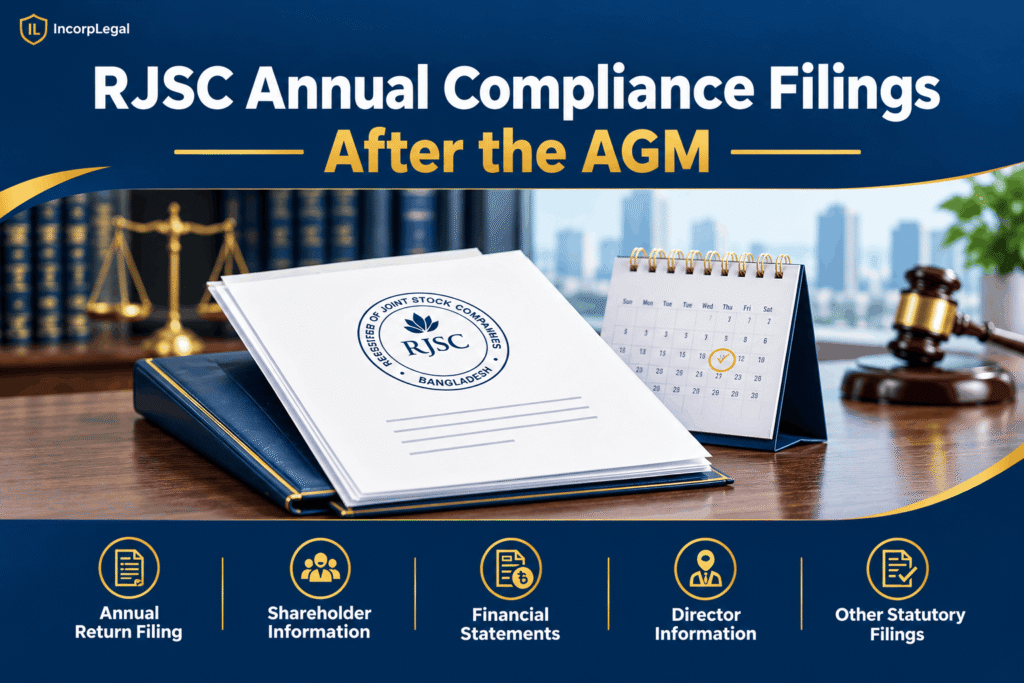
Once the AGM is held, the annual return filing at RJSC starts. Both filings are made online through the RJSC portal:
- Schedule X (annual return): a summary of share capital, shareholders and directors, due within 21 days of the AGM (section 36).
- Audited balance sheet and profit and loss account: due within 30 days of the AGM.
Some filings are event-driven and fall due during the year:
- Form XII: any appointment, resignation or change of director, within 14 days.
- Form 23B: the auditor’s notice of appointment, within 30 days of being informed.
- Special resolutions: filed with RJSC within 15 days of being passed.
Tax, VAT and Other Regulatory Compliance
Corporate income tax return. Under the Income Tax Act 2023, a company files by its “Tax Day”: the 15th day of the seventh month after the income year ends, or 15 September, whichever is later. For a June year-end company, that is 15 January. NBR has extended the company deadline in recent years, so check the current notice on the NBR website each season.
VAT and withholding tax. Companies registered for VAT (holding a BIN, the business identification number) file the monthly VAT return, Mushak 9.1, by the 15th of the following month. Tax deducted at source from payments to suppliers and staff must also be deposited and reported on NBR’s schedule.
Trade license renewal. The trade license issued by your city corporation or municipality runs for the July–June fiscal year. Renew it early in each fiscal year, as late renewal attracts surcharges.
Extra steps for foreign-owned companies. Expect a few additional obligations:
- Renew work permits and visas for expatriate staff before they expire.
- Report foreign investment and remittances to Bangladesh Bank and BIDA through your bank, as required.
- Keep encashment certificates and up-to-date RJSC filings on hand. Banks ask for them before remitting dividends abroad (see our guide to profit repatriation).
Corporate Compliance Calendar for Bangladesh Companies
The calendar below assumes a 30 June year-end, the most common choice in Bangladesh. Shift the dates if your income year ends elsewhere.
| When | Obligation | Authority |
|---|---|---|
|
15th of every month
|
VAT return (Mushak 9.1)
|
NBR |
|
July |
Renew trade license for the new fiscal year
|
City corporation / municipality
|
|
July–September
|
Close the books; statutory audit; obtain DVC
|
Auditor / ICAB
|
|
October–December
|
Board approves accounts; send 14 days’ notice; hold AGM
|
Company
|
|
Within 21 days of AGM
|
File Schedule X annual return
|
RJSC
|
|
Within 30 days of AGM
|
File audited balance sheet and P&L
|
RJSC
|
|
15 January
|
Corporate income tax return (unless NBR extends)
|
NBR
|
|
31 March
|
Latest practical AGM date under the nine-month rule
|
Company
|
|
Within 14 days of any change
|
Form XII for director changes
|
RJSC
|
Holding the AGM before the tax deadline is good practice, as your tax return relies on the same audited accounts.
Penalties for Missing Annual Compliance Deadlines
The Companies Act fines both the company and every officer in default for missing an AGM or a filing. RJSC also charges late fees that keep growing the longer a return is outstanding. Missed tax returns bring their own penalties under the Income Tax Act 2023.
The practical cost is often bigger than the fines:
- A missed AGM window can mean a High Court petition before RJSC will accept your filings.
- Banks may hold dividend remittances until your filings are current.
- Work permit renewals, share transfers and capital increases can stall over outdated records.
- Years of non-filing can lead RJSC to treat the company as defunct and strike it off.
If your company is no longer trading, a planned closure is usually cheaper than years of catch-up filings. See how to close a company in Bangladesh.
How IncorpLegal Helps
IncorpLegal acts as your company secretary in Bangladesh. We track every deadline, prepare AGM notices and minutes, coordinate the audit, and file Schedule X, accounts and director changes with RJSC. We also handle trade license renewals and tax and regulatory filings, so foreign shareholders get one point of contact. New to the market? Start with our guide to company registration in Bangladesh.
Frequently Asked Questions
When must a company in Bangladesh hold its AGM?
The first AGM must be held within 18 months of incorporation. After that, a company must hold one AGM in every calendar year, no more than 15 months after the previous one. The audited accounts presented should cover a period ending no more than nine months before the meeting, so a June year-end company should hold its AGM by 31 March.
What is the deadline for filing the RJSC annual return?
The annual return, Schedule X, must be filed with RJSC within 21 days of the AGM. The audited balance sheet and profit and loss account follow within 30 days of the AGM. Both are filed online through the RJSC portal. Because the deadlines run from the AGM date, a late AGM pushes every later filing out of time.
What happens if a company misses annual filings?
The company and its officers face fines, and RJSC late fees build up the longer a return stays outstanding. A missed AGM may require a High Court petition to put right. Outdated filings can also delay dividend remittances, share transfers and work permit renewals, and long-term non-filing can lead to the company being struck off.
Is a statutory audit mandatory for private companies?
Yes. The Companies Act 1994 requires every company, including private limited companies, to have its annual accounts audited by a qualified chartered accountant. The audited accounts are presented at the AGM, filed with RJSC and used for the tax return. Audit reports also need a Document Verification Code (DVC) issued through ICAB.
Do dormant companies need to file annual returns?
Yes. The Companies Act has no general exemption for dormant companies, so they must still hold an AGM, have accounts audited, file Schedule X and accounts with RJSC, and submit a tax return. If the company has no future use, closing it formally through winding up or strike off usually costs less than keeping it compliant.

Md. Akber Hossain Khan, FCA
A Fellow Chartered Accountant (Bangladesh) and alumnus of the National University of Singapore (NUS), Khan's practice focuses on inbound foreign investment and supporting businesses in global expansion. He is deeply experienced in FDI, cross-border accounting BPO, audit, taxation, and corporate financial advisory.

Business Expansion & Corporate Advisory. Precision in Strategy, Excellence in Execution. Your gateway to Asia.
Services
Quick Links
Get In Touch
IncorpLegal, 2nd Floor, Venus Complex, Kha-199/3-4, Pragati Sarani, Middle Badda, Dhaka-1212, Bangladesh.
- Email: hello@incorplegal.com
- Phone: +880-1713143224
- Hours: Mon-Fri 9:00AM - 5:00PM
©2026 Incorp Legal All Rights Reserved