
Accounting Standards in Bangladesh: IFRS for Foreign-Owned Companies
Bangladesh uses International Financial Reporting Standards (IFRS). The Financial Reporting Council (FRC) adopted IFRS without modifications through a gazette notification on 2 November 2020, replacing the older locally numbered Bangladesh Financial Reporting Standards (BFRS). A foreign-owned company that counts as a public interest entity (PIE) must prepare its financial statements under IFRS as adopted by the FRC. A PIE is broadly any company with BDT 500 million or more in revenue, or two of three size tests on liabilities, assets and headcount. Smaller companies have more flexibility. In practice, most foreign-owned companies prepare IFRS accounts anyway, because auditors, banks and the tax authority expect them.
This guide explains the framework, who must use full IFRS, the local points that catch foreign groups out, and how to line up your Bangladesh accounts with group reporting.
Key takeaways
- The FRC, created under the Financial Reporting Act 2015, sets accounting and auditing standards in Bangladesh.
- IFRS Accounting Standards were adopted in full in 2020, and International Standards on Auditing (ISA) apply to audits.
- PIEs must use IFRS as adopted by the FRC. They include all listed companies, banks, insurers and NBFIs, plus companies above size thresholds.
- The IFRS for SMEs standard is also available, mainly for smaller unlisted entities.
- Local statutory accounts must be in IFRS even if your group reports under US GAAP or another framework, so plan a reconciliation.
The Legal Framework for Accounting in Bangladesh
Several laws and bodies shape how companies keep and report their accounts:
| Law or body | Role |
|---|---|
|
Companies Act 1994 |
Requires every company to keep proper books of account, prepare annual financial statements and have them audited |
|
Financial Reporting Act 2015 |
Created the Financial Reporting Council (FRC) and requires PIEs to apply the standards the FRC adopts |
|
Financial Reporting Council (FRC) |
Adopts accounting and auditing standards, and oversees the financial reporting and audits of PIEs. It supervises 7,500+ PIEs |
|
ICAB and ICMAB |
Professional bodies for chartered and cost and management accountants. Only ICAB members can sign statutory audits |
|
Sector regulators |
Bangladesh Bank, the insurance regulator and the securities regulator add rules for banks, NBFIs, insurers and listed companies |
|
NBR |
Under the Finance Act 2026, requires IFRS-based audited financial statements with company tax returns |
Where a sector law prescribes a specific accounting treatment, for example for banks, that law can override parts of IFRS for those entities. For an ordinary foreign-owned trading, manufacturing or services company, IFRS as adopted by the FRC is the reference point.
From BFRS to IFRS
For many years, ICAB issued Bangladesh Financial Reporting Standards (BFRS) and Bangladesh Accounting Standards (BAS). These were IFRS and IAS with local numbering and a few changes. ICAB moved to IFRS terminology for periods beginning on or after 1 January 2018.
The decisive step came from the FRC. Through Gazette Notification No. 146 of 2 November 2020, it adopted IFRS Accounting Standards without modifications under an agreement with the IFRS Foundation. Since then:
- Statements refer to IFRS and IAS, not BFRS and BAS. Old references in templates or group manuals should be updated.
- New and amended IFRS standards apply in Bangladesh in line with the FRC’s adoption process and effective dates.
- Audits follow International Standards on Auditing (ISA), also adopted by the FRC without modifications.
- The FRC has signalled that it plans to adopt the IFRS sustainability disclosure standards (S1 and S2) for PIEs.
For a foreign group already using IFRS, this is good news: there is no separate national GAAP to learn, only local laws and regulators’ requirements layered on top.
Who Must Use Full IFRS?
The key question is whether your company is a public interest entity (PIE) under the Financial Reporting Act 2015.
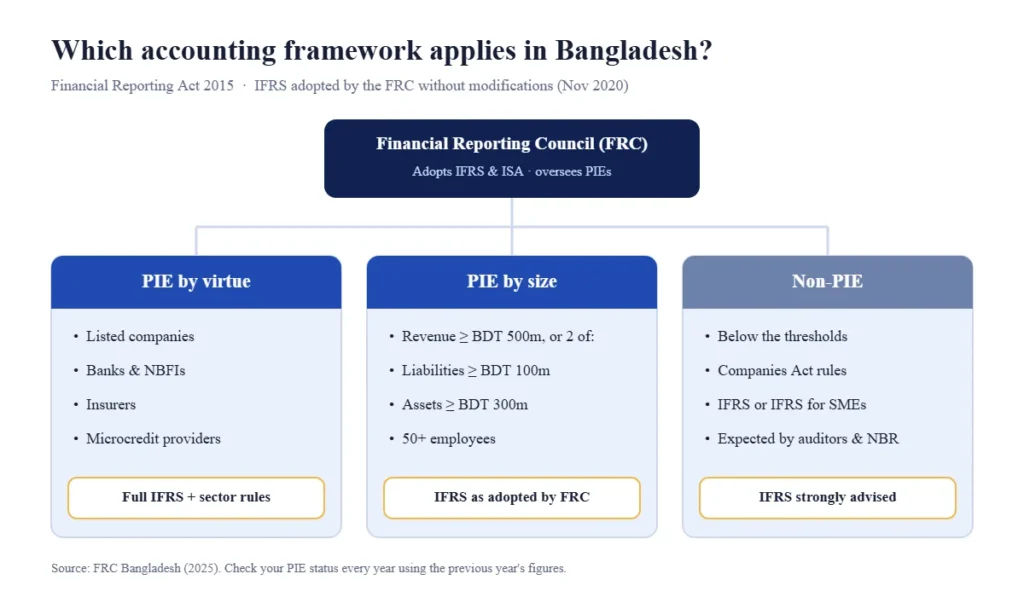
| Category | Who | Reporting framework |
|---|---|---|
|
PIE by virtue |
Listed companies, banks, non-bank financial institutions, insurers, microcredit providers |
Full IFRS as adopted by the FRC, plus sector rules |
|
PIE by size |
Other companies with revenue of BDT 500 million or more in the previous year, or any two of: liabilities of BDT 100 million or more, assets of BDT 300 million or more, 50 or more employees |
IFRS (or IFRS for SMEs where permitted) as adopted by the FRC |
|
Non-PIE |
Companies below the thresholds |
Companies Act requirements. IFRS or IFRS for SMEs is common practice and expected by auditors and the NBR |
What this means for foreign-owned companies:
- A foreign-owned subsidiary with a few hundred staff, a factory or a sizeable balance sheet will often be a PIE through the size tests, even if it isn’t listed.
- PIE status brings FRC oversight: your auditor must be enlisted with the FRC, and your financial statements may be reviewed by its monitoring division.
- Check your status every year, because the tests use the previous year’s figures.
- Even non-PIEs should assume IFRS. The Finance Act 2026 requires IFRS-based audited statements with company tax returns.
Key Standards and Local Points for Foreign-Owned Companies
IFRS is the same everywhere, but some areas need extra care in Bangladesh:
| Area | Standard | What to watch in Bangladesh |
|---|---|---|
|
Foreign currency |
IAS 21 |
Functional currency is usually BDT. Intercompany balances, import payables and foreign loans create exchange differences, especially after recent taka depreciation |
|
Revenue |
IFRS 15 |
Export sales, incentives and VAT treatment must be separated from revenue correctly |
|
Leases |
IFRS 16 |
Office, factory and land leases come on balance sheet. Long-term land leases in EPZs and economic zones need careful assessment |
|
Employee benefits |
IAS 19 |
Gratuity, provident fund and WPPF obligations under the Labour Act need actuarial or reasonable estimates |
|
Income taxes |
IAS 12 |
Deferred tax on differences between IFRS figures and tax rules (depreciation, provisions). Uncertain tax positions need disclosure |
|
Related parties |
IAS 24 |
Full disclosure of transactions with the parent and group companies, which links to transfer pricing |
|
Financial instruments |
IFRS 9 |
Expected credit losses on receivables, including intercompany balances |
|
Consolidation |
IFRS 10 |
Usually not needed locally unless the Bangladesh company itself has subsidiaries |
Related-party disclosures and intercompany balances are where accounting meets tax. Keep them consistent with your transfer pricing documentation.
Group GAAP vs Local IFRS: Making the Two Work Together
Most foreign-owned companies report twice: a monthly or quarterly group reporting pack under the parent’s framework, and annual statutory accounts under IFRS in Bangladesh. The two often differ in framework, year-end and level of detail.
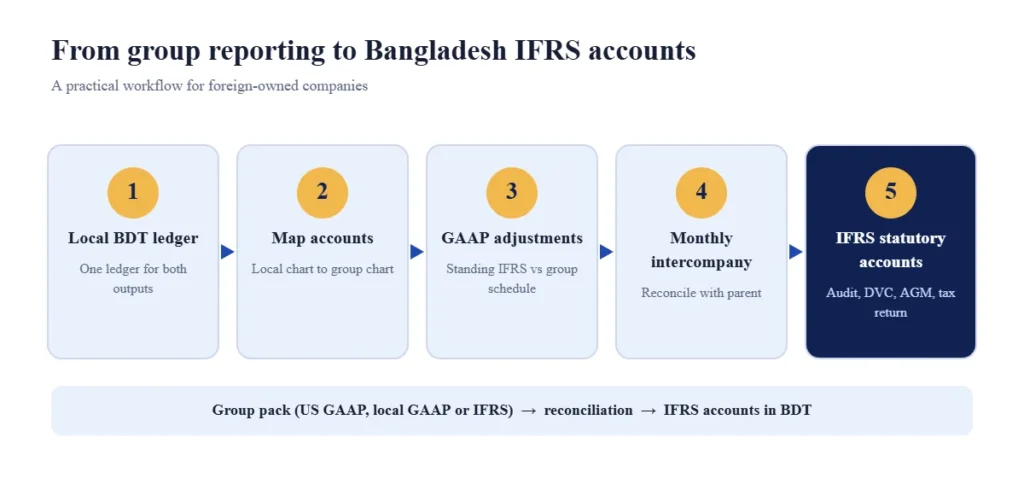
A practical workflow:
- Keep one local ledger in BDT, structured so it can produce both outputs.
- Map the local chart of accounts to the group chart of accounts once, and maintain the mapping.
- Identify framework differences (for example US GAAP vs IFRS on leases, revenue or impairment), and keep a standing adjustments schedule.
- Align year-ends. If the group uses December but Bangladesh tax uses June, plan two closes, or confirm whether an alternative year-end is allowed for your company.
- Reconcile intercompany balances monthly, not just at year-end, so the parent and the Bangladesh entity agree.
- Prepare a reconciliation from group reporting to the IFRS statutory accounts for the auditor.
- Agree the timetable with both group and local auditors, so the local audit, AGM and tax deadlines are met.
Getting this right shortens the local audit, avoids late filings and makes repatriating profits much smoother.
Books, Records, Currency and Financial Year
- Books of account: the Companies Act requires proper books of account kept at the registered office, giving a true and fair view of the company’s affairs. Keep them for at least the period required under the Companies Act and tax law. Many advisers recommend keeping records for 12 years or more.
- Currency: statutory accounts and tax returns are in Bangladeshi taka (BDT). Foreign currency transactions are translated under IAS 21.
- Language: accounts are normally prepared in English, the standard for audited statements, banks and regulators.
- Financial year: most companies follow the 1 July to 30 June income year used for tax. Banks, insurers and some financial institutions use the calendar year. Confirm the right year-end for your company before you set up your systems.
- Electronic records: accounting software is widely used. Make sure it can produce BDT ledgers, VAT records and the audit trail auditors and tax officers expect.
- Supporting documents: keep invoices, VAT forms (Mushak), bank statements, encashment certificates and intercompany agreements together. Auditors, tax officers and banks will ask for them.
Practical Checklist for Foreign-Owned Companies
- Confirm each year whether your company is a PIE under the FRC size tests
- If you are a PIE, appoint an FRC-enlisted auditor
- Set up the local ledger in BDT, mapped to the group chart of accounts
- Document IFRS accounting policies for revenue, leases, employee benefits, taxes and foreign currency
- Keep a standing schedule of group GAAP to IFRS adjustments
- Reconcile intercompany balances every month
- Estimate gratuity, provident fund and WPPF obligations
- Calculate deferred tax under IAS 12
- Prepare complete related-party disclosures, consistent with transfer pricing
- Agree the audit timetable to meet AGM and tax deadlines
- Make sure the audit report carries a valid DVC (see our statutory audit guide)
How IncorpLegal Helps
IncorpLegal helps foreign-owned companies keep their Bangladesh reporting compliant and aligned with the group:
- Reporting set-up: advising on the right framework, PIE status, year-end and record-keeping when you enter Bangladesh.
- Audit and AGM coordination: auditor appointment, board approval of accounts, AGM and RJSC filings.
- Intercompany documentation: agreements that support related-party disclosures, transfer pricing and remittances.
- Compliance calendar: lining up month-end, audit, tax and repatriation deadlines.
- Working with your accountants: coordinating local accountants, auditors and group finance so everyone works from the same timetable.
Learn more about our corporate advisory services.
Setting up or fixing your Bangladesh reporting? Talk to our team.
Frequently Asked Questions
Yes. The Financial Reporting Council adopted IFRS Accounting Standards without modifications through a gazette notification on 2 November 2020. Public interest entities must use IFRS as adopted by the FRC, and IFRS is the expected framework for most other companies.
PIEs include all listed companies, banks, NBFIs, insurers and microcredit providers. Other companies become PIEs if their revenue was BDT 500 million or more in the previous year, or if they meet two of three tests: liabilities of BDT 100 million or more, assets of BDT 300 million or more, or 50 or more employees.
BFRS (Bangladesh Financial Reporting Standards) were ICAB’s local versions of IFRS. Since 2018, and formally since the FRC’s 2020 adoption, Bangladesh uses IFRS Accounting Standards directly, so statements should refer to IFRS and IAS rather than BFRS and BAS.
The IFRS for SMEs standard is available in Bangladesh, mainly for smaller entities that are not publicly accountable. Check your PIE status and your auditor’s view first, because many foreign-owned companies meet the size tests or are expected to use full IFRS.
No. Statutory accounts in Bangladesh must follow IFRS as adopted locally. You can keep group reporting in your own framework, but you will need a reconciliation between group figures and the IFRS statutory accounts.
This article is for general information only and does not constitute accounting, audit or legal advice. Contact IncorpLegal and your chartered accountant for advice on your company’s situation.

Md. Akber Hossain Khan, FCA
A Fellow Chartered Accountant (Bangladesh) and alumnus of the National University of Singapore (NUS), Khan's practice focuses on inbound foreign investment and supporting businesses in global expansion. He is deeply experienced in FDI, cross-border accounting BPO, audit, taxation, and corporate financial advisory.

Business Expansion & Corporate Advisory. Precision in Strategy, Excellence in Execution. Your gateway to Asia.
Services
Quick Links
Get In Touch
IncorpLegal, 2nd Floor, Venus Complex, Kha-199/3-4, Pragati Sarani, Middle Badda, Dhaka-1212, Bangladesh.
- Email: hello@incorplegal.com
- Phone: +880-1713143224
- Hours: Mon-Fri 9:00AM - 5:00PM
©2026 Incorp Legal All Rights Reserved