
Branch vs Subsidiary in Bangladesh (and Liaison Office): Which Structure Fits Your Business?
If you plan to earn revenue in Bangladesh for the long term, a subsidiary (a locally incorporated private limited company) is usually the better choice. It ring-fences your liability, can be 100% foreign-owned, and gives you more flexibility on when and how profits leave the country. A branch office suits companies that need to operate under the parent’s name for specific projects. A liaison office fits only market research and coordination, because it cannot earn income.
Choosing between a branch and a subsidiary is the first structural decision every foreign company makes before entering Bangladesh. The choice shapes your liability, tax bill, approvals, staffing and how easily you can exit later. This guide compares all three entry structures side by side so you can choose with confidence.
Key takeaways
- A subsidiary is a separate legal entity; a branch and a liaison office are extensions of the foreign parent, which stays fully liable.
- Branches and liaison offices need BIDA permission and at least US$50,000 of inward remittance within two months of approval.
- Branch profits are taxed at 27.5% (25% if all transactions go through banks), plus 20% branch profit tax when remitted abroad, roughly the same headline burden as a subsidiary paying dividends.
- A liaison office cannot generate any income in Bangladesh; the parent funds all its costs.
- You cannot simply convert a branch into a subsidiary. Choosing correctly at the start saves a costly restructure later.
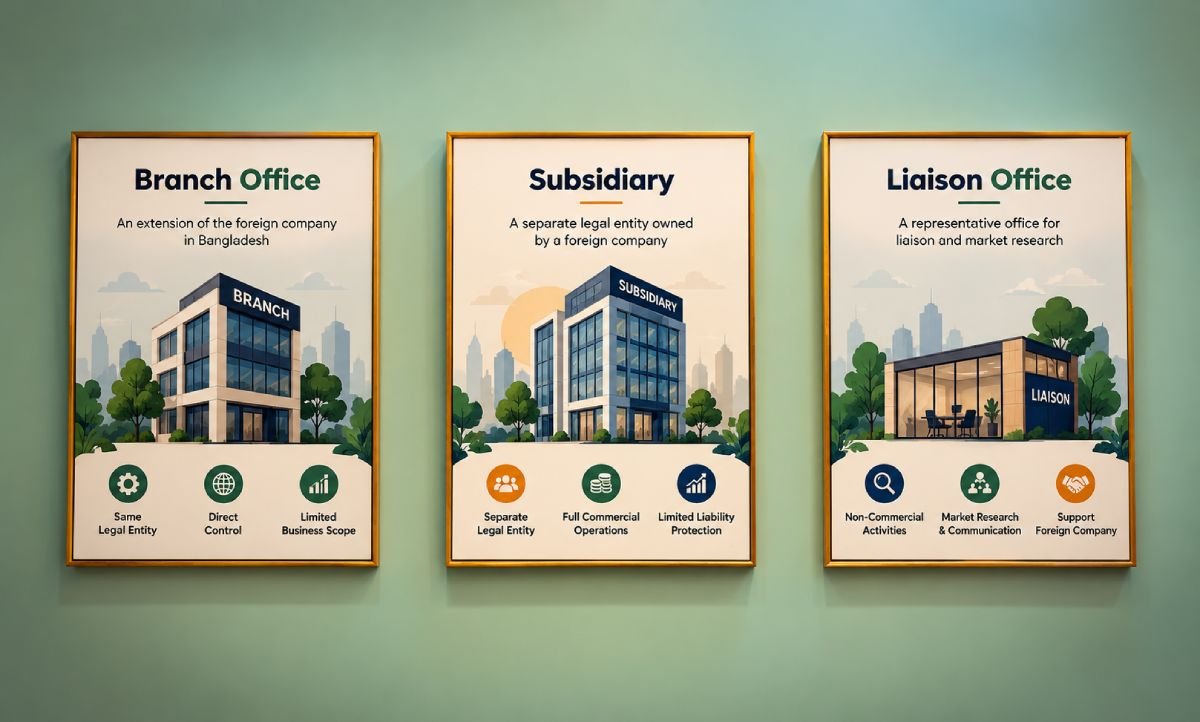
Your Options for Entering Bangladesh
Foreign companies have three main ways to set up a presence in Bangladesh:
- Subsidiary company: a private limited company incorporated with the Registrar of Joint Stock Companies and Firms (RJSC), owned wholly or partly by the foreign parent.
- Branch office: an extension of the foreign company, approved by the Bangladesh Investment Development Authority (BIDA), that can carry out approved commercial activities.
- Liaison office: a BIDA-approved representative office for promotion, coordination and market research only.
Each structure answers a different business need. The right one depends on whether you will earn revenue locally, how long you plan to stay, and how much risk the parent company is willing to carry. For a broader view of the entry process, see our guide to starting a business in Bangladesh as a foreigner.
What Is a Subsidiary Company in Bangladesh?
A subsidiary is a private limited company incorporated under the Companies Act 1994 and registered with the RJSC. It is a separate legal person, so its debts and obligations generally stay with the company, not the foreign parent.
Core requirements:
- Shareholders: minimum 2, maximum 50. Shareholders can be individuals or companies, so a foreign parent and one affiliate can hold all the shares.
- Directors: minimum 2. Foreign nationals can serve as directors.
- Foreign ownership: 100% foreign shareholding is permitted in most sectors. A few regulated sectors set caps or need special permission.
- Capital: company law sets no meaningful minimum capital. In practice, the capital you remit affects BIDA registration, work permits for expatriate staff and your bank's onboarding checks.
- Registered office: a local address in Bangladesh is mandatory.
How it is set up: name clearance at RJSC, incorporation, opening a corporate bank account, remitting share capital through banking channels (backed by an encashment certificate), then BIDA registration, tax (TIN), VAT (BIN) and trade license registrations. Our company registration guide walks through each step.
Best for: companies that plan to sell, manufacture, provide services or hire locally over the long term.
What Is a Branch Office in Bangladesh?
A branch office is the foreign company itself operating in Bangladesh. It has no separate legal identity, so the parent company is fully responsible for the branch’s activities, debts and obligations.
Core requirements:
- Approval: permission from BIDA, issued after review by an inter-ministerial committee and a security clearance.
- Directors: minimuInward remittance: at least US$50,000 must be brought into Bangladesh within two months of the BIDA permission letter.m 2. Foreign nationals can serve as directors.
- Validity: permission is usually granted for an initial period of up to three years and must be renewed. Apply for renewal at least two months before expiry.
- Parent company: BIDA generally expects an established parent with a track record, supported by audited accounts.
- Activities: only the activities named in the BIDA permission letter. A branch can earn local income from those activities.
- Reporting: periodic income and expenditure reporting to BIDA, the bank, the National Board of Revenue (NBR) and Bangladesh Bank, plus an annual audit and tax return.
Timeline: expect around 60 to 90 days from application to a fully operational branch, including BIDA approval, bank account, remittance and registrations.
Best for: contractors and service providers on defined projects who need to contract in the parent’s name. For the full process, see our branch office registration guide.
What Is a Liaison Office in Bangladesh?
A liaison office (sometimes called a representative office) is the parent company’s communication channel in Bangladesh. It cannot generate any income locally. The parent company covers all its operating expenses through inward remittances.
Permitted activities typically include:
- Promoting the parent company's products and services
- Market research and exploring business opportunities
- Coordinating with local buyers, suppliers and partners
- Acting as a contact point between the parent and Bangladeshi stakeholders
Not permitted: selling, invoicing, signing commercial contracts in its own right or earning any fee or commission in Bangladesh.
Like a branch, a liaison office needs BIDA permission, at least US$50,000 of inward remittance within two months of approval, periodic reporting, and renewal before its permission expires.
Best for: companies testing the market, sourcing offices (common in the garment sector) and firms that want a local presence before committing to full operations.
Branch vs Subsidiary vs Liaison Office: Side-by-Side Comparison
| Factor | Subsidiary (private limited) | Branch office | Liaison office |
|---|---|---|---|
| Legal status | Separate legal entity | Part of the foreign parent | Part of the foreign parent |
| Parent's liability | Generally limited to share capital | Unlimited: parent fully liable | Unlimited: parent fully liable |
| Can earn income locally? | Yes | Yes, approved activities only | No |
| Main approval | RJSC incorporation, then BIDA registration | BIDA permission | BIDA permission |
| Minimum funding | No statutory minimum (capital affects work permits and banking) | US$50,000 inward remittance within 2 months of approval | US$50,000 inward remittance within 2 months of approval |
| Validity | Perpetual until wound up | Time-limited (commonly up to 3 years), renewable | Time-limited, renewable |
| Ownership | Up to 100% foreign in most sectors | 100% owned by the parent | 100% owned by the parent |
| Corporate tax | 27.5% (25% if all transactions are banked) | Same rate on Bangladesh income | No taxable business income (staff payroll taxes still apply) |
| Tax on sending profits home | 20% withholding on dividends to foreign companies (may be lower under a tax treaty) | 20% branch profit tax on remitted profits | Not applicable |
| Typical setup time | A few weeks to incorporate, longer with BIDA, bank and tax registrations | Around 60–90 days | Around 60–90 days |
| Contracts signed by | The subsidiary | The foreign parent | Cannot sign commercial contracts |
| Exit | Winding up or strike off through RJSC | Closure with BIDA, Bangladesh Bank and tax clearance | Closure with BIDA, Bangladesh Bank and tax clearance |
| Best for | Long-term operations, hiring, manufacturing, local sales | Defined projects under the parent's name | Market research, sourcing, coordination |
Tax Treatment: Branch vs Subsidiary
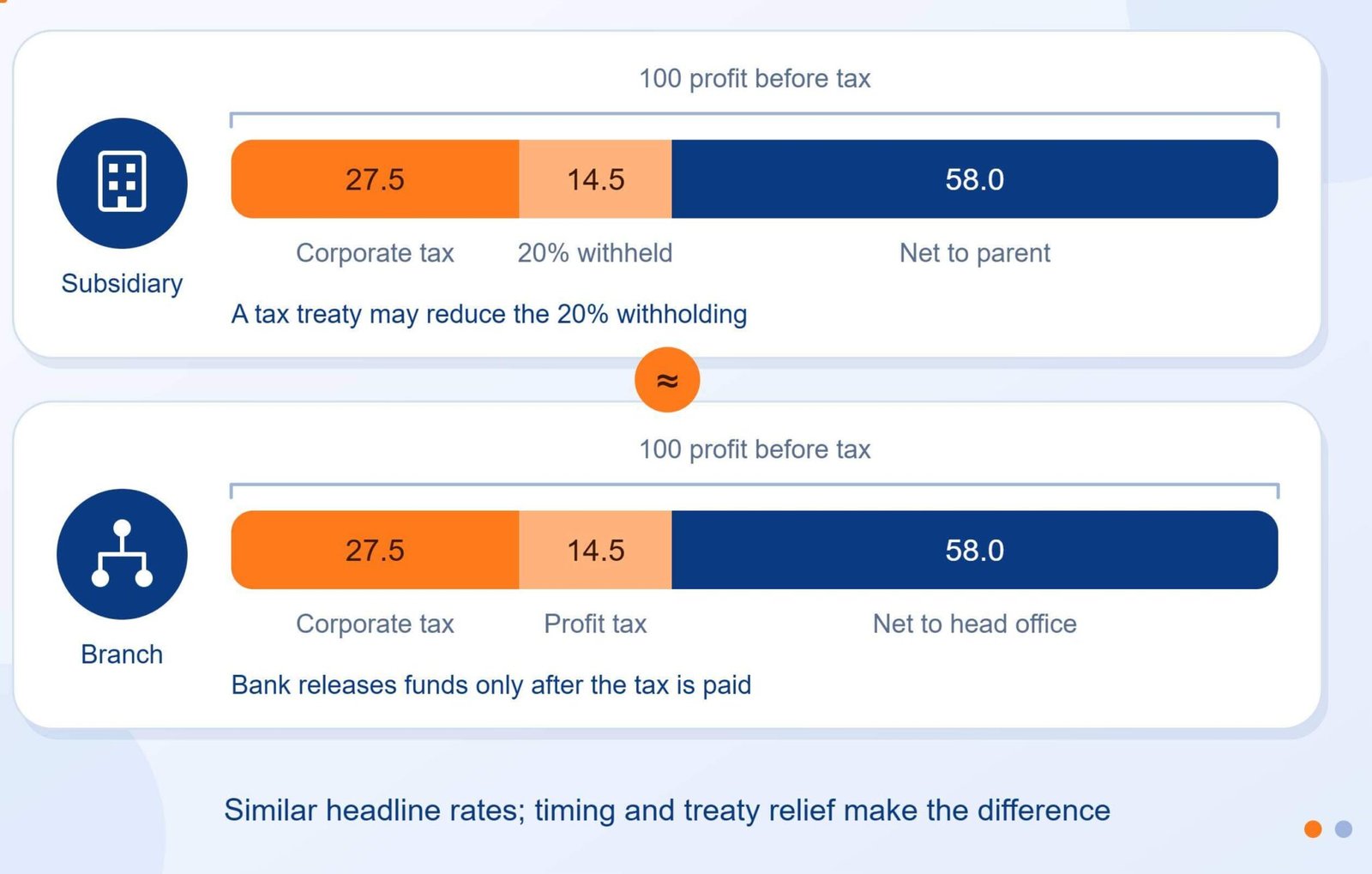
On headline rates, a branch and a subsidiary pay about the same. The real differences are timing, treaty relief and how the tax authority treats dealings with the parent.
Subsidiary. The company pays corporate income tax at 27.5% on its profits, or 25% if all receipts and payments go through banking channels. When it pays dividends to a foreign parent company, 20% tax is withheld. A double tax treaty between Bangladesh and the parent’s home country may reduce that withholding rate. Profits can also be kept and reinvested in Bangladesh, which delays the second layer of tax.
Branch. Branch income from Bangladesh is taxed at the same non-listed company rate. When after-tax profits are sent to the head office, a further 20% branch profit tax applies. The authorised dealer bank will not process the remittance until that tax has been deposited.
Worked example (illustrative only, before treaty relief):
| Step | Subsidiary | Branch |
|---|---|---|
| Profit before tax | 100 | 100 |
| Corporate tax at 27.5% | (27.5) | (27.5) |
| Profit after tax | 72.5 | 72.5 |
| 20% dividend withholding / branch profit tax on full remittance | (14.5) | (14.5) |
| Net amount reaching the parent | 58.0 | 58.0 |
What actually tips the balance:
- Treaty rates: many treaties cap dividend withholding below 20%, which can favour a subsidiary. Check the treaty for your home country.
- Head-office charges: deductions for expenses charged by the parent to a branch are restricted, which can raise the branch's taxable profit.
- Home-country tax: some countries tax foreign branch profits as they arise, while dividends from subsidiaries may be exempt. Take advice in both jurisdictions.
- Liaison offices earn no business income, so there is no corporate tax on profits, but salaries paid to staff remain subject to withholding and personal income tax.
Rates are as of the 2026–27 income year. Bangladesh tax rules change with each Finance Act, so confirm current rates before you decide.
Which Structure Fits Your Business?
Match your plans to the structure built for them:
| Your situation | Recommended structure | Why |
|---|---|---|
| You will manufacture, sell to local customers or build a team in Bangladesh | Subsidiary | Separate legal entity, perpetual existence, full commercial freedom, easier to bring in local partners later |
| You won a contract (for example, infrastructure, power or engineering) that must be performed in the parent's name | Branch office | Contracts stay with the parent, which already holds the track record and qualifications the client requires |
| You want to source products, manage suppliers or study the market before committing | Liaison office | Lowest commitment and no local revenue, but a recognised presence and the ability to employ staff |
| You are testing the market but expect to sell within 12–18 months | Subsidiary from day one | Avoids closing a liaison office and setting up again later |
| You need to limit the parent's exposure to local claims | Subsidiary | Liability generally stays with the local company |
A simple rule of thumb: if you will invoice customers in Bangladesh on an ongoing basis, start with a subsidiary. Use a branch for specific projects, and a liaison office only when you will not earn anything locally.
Whichever you choose, BIDA is your main regulator as a foreign investor. Our BIDA registration guide explains what to expect.
Can You Convert a Branch or Liaison Office into a Subsidiary?
Not directly. Bangladesh has no simple conversion filing. Moving from a branch or liaison office to a subsidiary is a two-track process:
- Set up the subsidiary: incorporate the new private limited company with RJSC, open its bank account, remit share capital and complete BIDA, tax and VAT registrations.
- Move the business: transfer staff, assets, leases and customer contracts to the subsidiary. Contracts usually need the counterparty's consent.
- Close the old office: obtain tax clearance, settle liabilities, inform BIDA and Bangladesh Bank, close or redirect bank accounts and repatriate any remaining funds.
Running both entities in parallel for a period is common, and it adds cost and compliance. That is why the structure you choose at the start matters. If you expect to grow into a full operation, starting with a subsidiary is usually cheaper than restructuring later.
How IncorpLegal Helps
IncorpLegal supports foreign companies through every stage of doing business in Bangladesh, from choosing the right structure to running it compliantly:
- Structure advice: we compare a branch, subsidiary and liaison office against your business plan, tax position and timeline.
- Setup: RJSC incorporation, BIDA permissions, corporate bank accounts, inward remittance and registrations through our company formation services in Bangladesh.
- Ongoing compliance: annual returns, BIDA and Bangladesh Bank reporting, renewals and tax filings.
- Restructuring and exit: moving from a liaison office or branch to a subsidiary, or closing an entity cleanly.
Not sure which structure fits? Book a free entry-structure consultation with our team.
Frequently Asked Questions
No. A branch office is part of the foreign parent company. The parent is fully responsible for the branch’s debts, obligations and actions in Bangladesh. If you need liability protection, a subsidiary is the better structure.
No. A liaison office cannot sell, invoice or earn any income in Bangladesh. It may only promote the parent, research the market and coordinate with local parties. The parent company funds all its expenses through inward remittances.
A subsidiary can usually be incorporated with RJSC faster than BIDA approves a branch. Once you add bank account opening, capital remittance and registrations, both typically take around two to three months to become fully operational.
Yes, in most sectors. Bangladesh allows 100% foreign ownership of private limited companies, with caps or special approvals in a small number of regulated sectors. A private company needs at least two shareholders, which can be the parent and an affiliate.
Yes. Branch and liaison offices of foreign companies need BIDA permission before they start operating. The permission is time-limited, requires at least US$50,000 of inward remittance within two months, and must be renewed before it expires.

Md. Akber Hossain Khan, FCA
A Fellow Chartered Accountant (Bangladesh) and alumnus of the National University of Singapore (NUS), Khan's practice focuses on inbound foreign investment and supporting businesses in global expansion. He is deeply experienced in FDI, cross-border accounting BPO, audit, taxation, and corporate financial advisory.

Business Expansion & Corporate Advisory. Precision in Strategy, Excellence in Execution. Your gateway to Asia.
Services
Quick Links
Get In Touch
IncorpLegal, 2nd Floor, Venus Complex, Kha-199/3-4, Pragati Sarani, Middle Badda, Dhaka-1212, Bangladesh.
- Email: hello@incorplegal.com
- Phone: +880-1713143224
- Hours: Mon-Fri 9:00AM - 5:00PM
©2026 Incorp Legal All Rights Reserved