
BIDA Registration for Foreign Investors in Bangladesh: A Complete Guide
If you’re planning to invest in Bangladesh, BIDA registration for foreign investors is one of the first regulatory steps you’ll need to understand. The Bangladesh Investment Development Authority (BIDA) is the government agency responsible for facilitating and recognizing foreign and joint-venture investment in the country. Depending on your business structure and sector, BIDA registration or approval may be required before you can fully operate, hire expatriate staff, or access certain banking and investment facilities. This guide walks through who needs BIDA registration, what it involves, how the approval process works, what it costs, and how it connects to foreign ownership rules and Bangladesh Bank compliance.
What Is BIDA Registration for Foreign Investors?
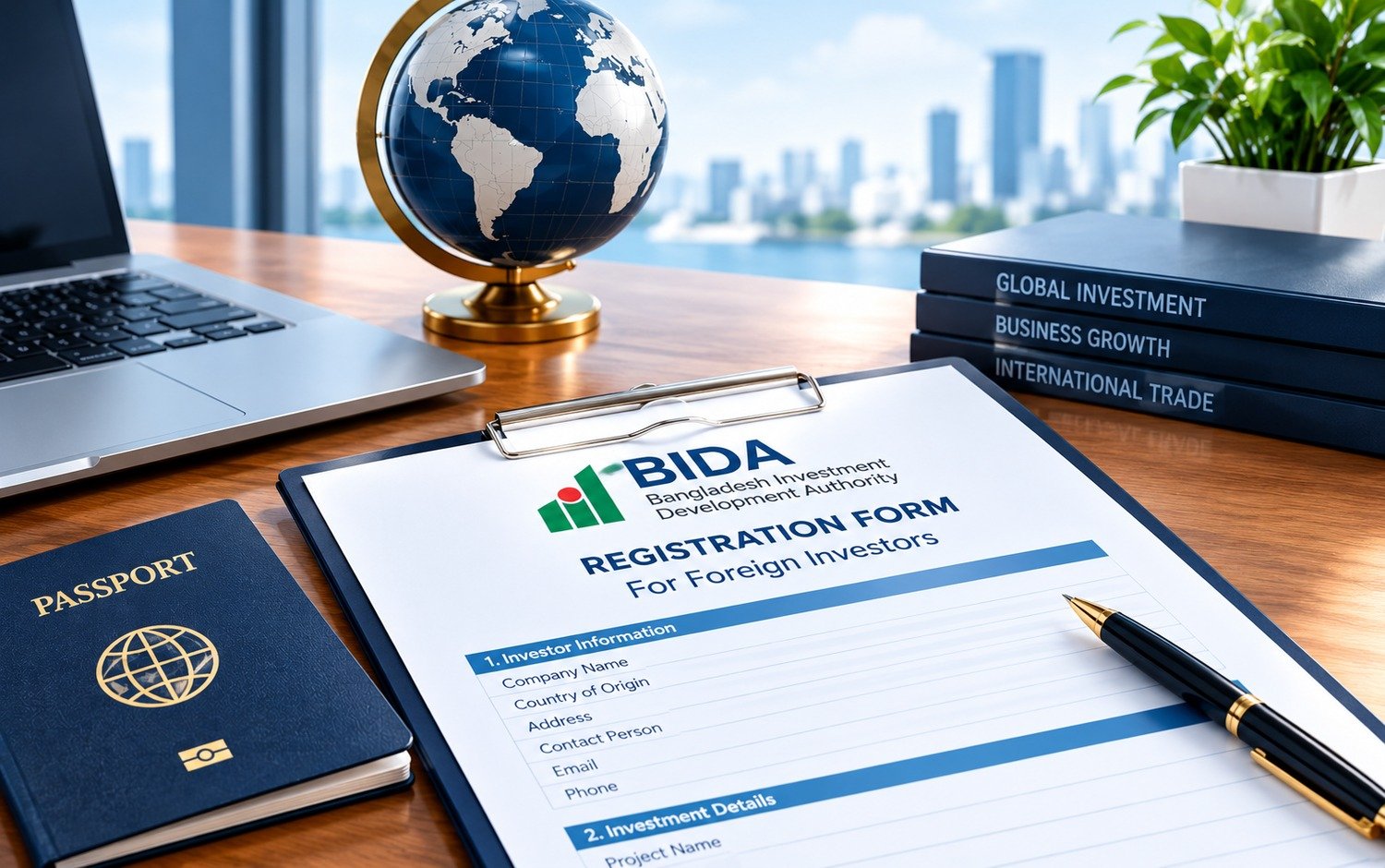
BIDA registration is the process by which a foreign, joint-venture, or foreign-owned business formally registers its investment project with Bangladesh’s investment promotion authority. It is distinct from company incorporation, which is handled separately by the Registrar of Joint Stock Companies and Firms (RJSC). Incorporation creates the legal entity; BIDA registration recognizes that entity’s investment and unlocks certain benefits and permissions tied to foreign capital, such as work permit eligibility and access to specific banking procedures.
For foreign and joint-venture investors, BIDA registration is closely tied to the broader investment lifecycle — from bringing in capital through proper banking channels to eventually repatriating profits. Because requirements can differ by sector, investment size, and business structure, investors should confirm the applicable BIDA requirements for their specific project before starting operations, rather than assuming a single standard process applies to every business.
Who Needs BIDA Registration in Bangladesh?
BIDA registration is generally relevant to foreign investors, wholly foreign-owned companies, joint ventures with local partners, and foreign companies establishing a branch, liaison, or representative office in Bangladesh. It is also connected to industrial and factory projects seeking recognition as a registered investment.
That said, the exact registration path and documentation differ depending on several factors:
- Whether the business is 100% foreign-owned or a joint venture
- The sector or industry involved, including whether it falls under a controlled or restricted category
- The type of investment (industrial, commercial, service-based, or office presence)
- Whether the entity is registering a new project or amending an existing one
Because of this variation, it’s not accurate to assume every foreign business in Bangladesh follows an identical BIDA process. Confirming the applicable category early helps avoid delays later.
BIDA Registration Requirements
BIDA registration requirements vary based on investment structure and business activity, but applications for foreign and joint-venture projects typically call for several categories of documentation:
- Company formation documents: Certificate of Incorporation, Memorandum and Articles of Association (where a limited company is involved)
- Shareholding and director information: list of directors with nationality and address, shareholding structure
- Identity documents: passport copies of foreign investors and directors
- Investment and project information: project profile (often required for larger projects), nature and scale of the proposed business activity
- Property documentation: land purchase or rental agreement for the project site
- Regulatory documents: up-to-date Trade License and Tax Identification Number (TIN) certificate, and a No Objection Certificate (NOC) from the relevant ministry for controlled sectors
- Banking-related documents: evidence connected to capital remittance, relevant at later stages of the process
This is not an exhaustive checklist — BIDA may request additional documents depending on the sector, investment size, or whether the application involves a new registration or an amendment. Investors should verify the current document list on the BIDA One Stop Service (OSS) portal or with a qualified advisor before submission. [Internal Link: Foreign Investment Services]
BIDA Approval Process in Bangladesh
The BIDA approval process in Bangladesh generally follows these stages, though the exact sequence and duration can vary by investment type:
- Determine the investment structure — wholly foreign-owned, joint venture, branch, or liaison office.
- Incorporate the relevant entity, where applicable, through RJSC before or alongside the BIDA application.
- Prepare the required corporate and investment documents, including shareholding, project, and identity information.
- Submit the application online through the BIDA OSS portal, along with the prescribed application fee.
- Provide supporting documents and clarifications as requested during BIDA's review.
- Respond to any additional queries raised by BIDA officials during verification.
- Receive the registration certificate once BIDA completes its review and approves the application.
- Complete post-registration steps, such as converting temporary bank accounts to permanent ones and pursuing other applicable licenses.
Processing timelines depend on the completeness of the application and the nature of the project, so investors should not expect a fixed or guaranteed turnaround. Incomplete documentation or sector-specific clearances (like ministry NOCs) can extend the timeline. [Internal Link: Company Formation Services]
BIDA Registration Cost in Bangladesh
BIDA registration cost in Bangladesh is not a flat fee — it is generally tied to the size of the proposed investment, with government application fees scaling across investment tiers. Beyond the BIDA application fee itself, investors typically budget for several other cost categories:
- Company incorporation costs with RJSC
- Professional or legal service fees for document preparation and filing
- Sector-specific licensing or NOC-related costs
- Ongoing compliance costs (trade license renewal, TIN/VAT registration, annual filings)
Because government fee schedules are updated periodically, investors should confirm the current fee structure directly on the official BIDA portal at the time of application rather than relying on older published figures.
Foreign Ownership Rules in Bangladesh
Bangladesh generally permits 100% foreign ownership across most sectors, alongside joint ventures with local partners. However, foreign ownership rules in Bangladesh are not uniform — certain sectors, such as freight forwarding, courier services, and advertising agencies, require local ownership or participation, and other sectors may be classified as controlled or restricted, requiring ministry-level clearance before registration.
Because sector classification directly affects whether a wholly foreign-owned structure is available, investors should confirm the ownership rules applicable to their specific industry before finalizing a business structure. [Internal Link: Corporate Advisory Services] This is particularly important for sectors tied to national security, media, or specific regulated industries, where restrictions are more likely to apply.
BIDA Work Permit Bangladesh
Employing foreign staff in Bangladesh typically requires separate work authorization, and BIDA plays a facilitating role in this process for registered investment projects. A BIDA work permit in Bangladesh is not automatically granted simply because a company completes investment registration — it is a distinct process tied to the specific employee, position, and employer.
Employers are generally responsible for initiating the relevant security clearance and work permit applications for expatriate staff through the appropriate channels, which BIDA’s One Stop Service portal has increasingly centralized. Because requirements can depend on the employee’s role, nationality, and the company’s registration status, it’s advisable to plan work permit applications separately from — but alongside — the core BIDA registration process. [Internal Link: Employment & Immigration Services]
Bangladesh Bank Compliance and Foreign Exchange Rules

Foreign capital entering Bangladesh must come through proper banking channels to be recognized under Bangladesh Bank compliance for companies. Investors typically open a temporary bank account to receive inbound capital, after which the receiving bank issues an encashment certificate confirming the funds were converted from foreign currency. This certificate is important evidence for both BIDA registration and future profit repatriation.
Foreign exchange compliance in Bangladesh also governs how dividends and profits are repatriated — generally through an Authorized Dealer (AD) bank, supported by documentation such as audited financials, tax clearance certificates, and board resolutions. Reporting obligations apply to both the investor and the bank. Because these rules involve transaction-specific documentation and regulatory review, this overview should not be treated as financial or banking advice — investors should confirm requirements with their bank and Bangladesh Bank guidelines directly. [Internal Link: Corporate Bank Account Opening Services]
What Happens After BIDA Registration?
BIDA registration is an important milestone, not the end of compliance obligations. After registration, foreign-owned and joint-venture companies typically need to address:
- Tax registration (TIN) and, where applicable, VAT/BIN registration
- Trade license renewal
- Sector-specific operating licenses
- Ongoing corporate filings with RJSC
- Continued foreign investment and foreign exchange reporting
Staying current on these obligations helps maintain the company’s standing and avoids complications with future banking or repatriation processes. [Internal Link: Regulatory Compliance & Licensing Services]
Why Choose IncorpLegal for BIDA Registration?
Navigating BIDA registration alongside company formation, banking, and immigration requirements can be complex, particularly for investors unfamiliar with Bangladesh’s regulatory landscape. IncorpLegal assists foreign investors with BIDA registration, foreign investment advisory, company formation, corporate bank account opening, work permit and immigration support, regulatory licensing, legal documentation, and ongoing corporate compliance.
Our team helps investors determine the correct registration path for their specific structure and sector, prepare accurate documentation, and coordinate with BIDA, RJSC, and banking partners throughout the process. If you’re planning to invest in Bangladesh and want clarity on your BIDA registration requirements, contact IncorpLegal to discuss your project.

Frequently Asked Questions
It’s the process of formally registering a foreign or joint-venture investment project with Bangladesh’s investment authority, separate from company incorporation with RJSC.
Requirements vary by structure and sector, but most foreign-owned and joint-venture businesses need some form of BIDA registration or approval.
Typical requirements include incorporation documents, shareholding and director details, identity documents, project information, and sector-specific clearances.
Timelines vary depending on documentation completeness and sector; there is no fixed guaranteed processing time.
Government fees scale with investment size, plus separate incorporation, licensing, and professional service costs. Confirm current fees with BIDA directly
BIDA facilitates related processes, but work permits are a separate application tied to the specific employee and role.
Internal Linking Opportunities:
- [Internal Link: Foreign Investment Services] — placed in the requirements section
- [Internal Link: Company Formation Services] — placed in the approval process section
- [Internal Link: Corporate Advisory Services] — placed in the ownership rules section
- [Internal Link: Employment & Immigration Services] — placed in the work permit section
- [Internal Link: Corporate Bank Account Opening Services] — placed in the banking/FX section
- [Internal Link: Regulatory Compliance & Licensing Services] — placed in the post-registration section
Suggested CTA:
Contact IncorpLegal today to determine your BIDA registration requirements and start your investment in Bangladesh with confidence.
Sources used for factual/legal verification:
- Bangladesh Investment Development Authority (BIDA) One Stop Service portal and official registration/fee documentation (investbangladesh.gov.bd; boi.gov.bd)
- Bangladesh Trade Portal — official BIDA registration checklist and fee schedule (bangladeshtradeportal.gov.bd)
- Bangladesh Bank — Guidelines for Foreign Exchange Transactions, Chapter 9 (bb.org.bd)
- Third-party legal/advisory summaries cross-checked against the above for process and documentation consistency (used only to corroborate, not as primary authority)

Md. Akber Hossain Khan, FCA
A Fellow Chartered Accountant (Bangladesh) and alumnus of the National University of Singapore (NUS), Khan's practice focuses on inbound foreign investment and supporting businesses in global expansion. He is deeply experienced in FDI, cross-border accounting BPO, audit, taxation, and corporate financial advisory.

Business Expansion & Corporate Advisory. Precision in Strategy, Excellence in Execution. Your gateway to Asia.
Services
Quick Links
Get In Touch
IncorpLegal, 2nd Floor, Venus Complex, Kha-199/3-4, Pragati Sarani, Middle Badda, Dhaka-1212, Bangladesh.
- Email: hello@incorplegal.com
- Phone: +880-1713143224
- Hours: Mon-Fri 9:00AM - 5:00PM
©2026 Incorp Legal All Rights Reserved