
Legal Due Diligence in Bangladesh: Checklist for Investors & Acquirers
Legal due diligence in Bangladesh is a structured review of a target company’s legal position before you invest in it, buy it or enter a joint venture with it. It checks whether the company legally exists in good standing, who really owns it, whether it holds the licences it needs, what its contracts and assets commit it to, and whether there are hidden liabilities in tax, employment, litigation or foreign exchange compliance.
In Bangladesh, records are spread across several authorities and are not always digitised or up to date, so a careful legal review matters more than in many markets. This guide gives you a practical checklist, highlights the red flags we see most often, and explains how findings should shape your deal.
Key takeaways
- Never rely only on documents supplied by the seller. Verify corporate records directly with the RJSC and other authorities.
- Foreign investors should look closely at foreign exchange compliance: encashment certificates, Bangladesh Bank reporting and past repatriations.
- Land and property title is one of the riskiest areas in Bangladesh and needs specialist review.
- There is no single national litigation database, so litigation checks need targeted searches and seller disclosures.
- Findings should feed directly into price, conditions precedent, warranties and indemnities in the transaction documents.
What legal due diligence covers
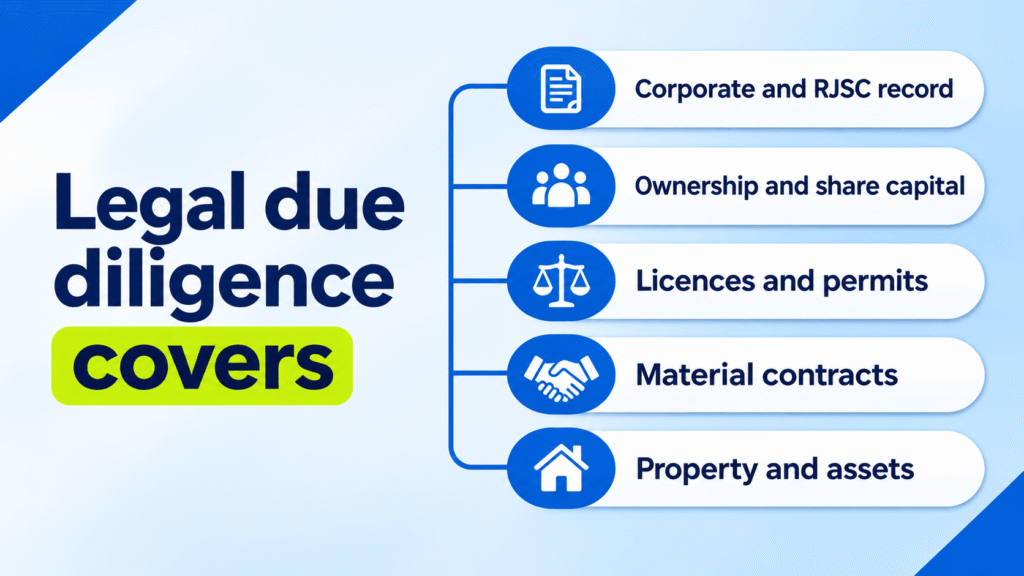
Legal due diligence (often shortened to “legal DD”) sits alongside financial, tax and commercial due diligence. Its job is to answer four questions:
- Does the company exist and is it in good standing?
- Who owns and controls it, and can the shares or assets be transferred to you?
- Is it lawfully allowed to do what it does?
- What legal liabilities and commitments come with it?
The output is a due diligence report that sets out the findings, rates the risks and recommends how to deal with each one in the deal.
When you need legal due diligence
- Share acquisitions: buying all or part of a Bangladeshi company. See our guide to mergers and acquisitions in Bangladesh.
- Asset purchases: buying a business, factory, brand or property.
- Joint ventures: partnering with a local company, where your partner’s history becomes your risk.
- Minority investments: private equity, venture capital or strategic stakes.
- Lending and security: taking security over shares, land or machinery.
- Distributor or supplier onboarding: a lighter review of a key commercial partner.
Legal due diligence checklist for Bangladesh
The scope should match the deal size and risk, but the following areas form the core of most reviews.
1. Corporate and RJSC records
- Certificate of Incorporation, Memorandum and Articles of Association, and all amendments
- Latest Schedule X (annual return) and Form XII (particulars of directors) filed with RJSC
- Board and shareholder minutes, especially for major decisions
- Statutory registers: members, directors, charges
- Status of annual filings, AGMs and audited accounts
How to verify: obtain certified copies directly from the Registrar of Joint Stock Companies and Firms (RJSC) and compare them with the company’s internal records. Mismatches between the two are common and must be fixed before closing.
2. Ownership and share capital
- Shareholding history from incorporation to date
- Returns of allotment and share transfer filings
- Share certificates and transfer instruments
- Any pledges, liens or options over shares
- Shareholders agreements, side letters and nominee or benami arrangements
Check that the shareholders agreement and Articles allow the proposed transfer, and identify any pre-emption rights, tag-along rights or consent requirements.
3. Licences and permits
- Trade license, TIN and BIN (VAT registration)
- BIDA, BEPZA or BEZA registration where relevant
- Import and export registration certificates (IRC/ERC)
- Fire, environmental clearance, factory and building approvals
- Sector licences, for example from Bangladesh Bank, BTRC, the Directorate General of Drug Administration or IDRA
- Whether licences are transferable or will be affected by a change of control
4. Material contracts
- Key customer, supplier, distribution and agency agreements
- Government contracts and tenders
- Loan, guarantee and security documents
- Leases and technology or licensing agreements
- Change-of-control, exclusivity, non-compete and termination clauses
- Whether contracts are properly stamped, as unstamped documents can face problems when enforced
5. Property and assets
- Title deeds, mutation records and land records (khatian) for owned land
- Chain of title over at least the period recommended by your property counsel
- Registered leases and landlord authority
- Charges and mortgages registered with RJSC and the land registry
- Ownership and insurance of key machinery and vehicles
6. Employment
- Appointment letters and service rules
- Compliance with the Bangladesh Labour Act 2006: working hours, leave, wages and festival bonuses
- Provident fund, gratuity and workers’ profit participation fund (WPPF) where applicable
- Work permits and visas for foreign staff
- Trade union activity, labour disputes and pending claims
Our guide to the Bangladesh Labour Act for foreign employers explains the main obligations.
7. Tax
- Corporate income tax returns and assessments from the National Board of Revenue (NBR)
- VAT returns and withholding tax (TDS/VDS) compliance
- Open tax audits, demands and appeals
- Tax clearance certificates
- Customs disputes for importers
Legal DD flags tax disputes and compliance gaps; a separate tax due diligence normally quantifies them.
8. Litigation and disputes
- Pending and threatened civil, criminal, labour and arbitration matters
- Cheque dishonour cases, which are common in commercial disputes in Bangladesh
- Regulatory investigations or show-cause notices
- Writ petitions involving the company before the High Court Division
9. Intellectual property
- Trademarks, patents and designs registered with the Department of Patents, Designs and Trademarks (DPDT)
- Copyright registrations and software licences
- Whether key brands are owned by the company or by a founder personally
10. Foreign exchange compliance
- Encashment certificates for all foreign capital brought in
- Bangladesh Bank reporting on share issuances and transfers involving non-residents
- Foreign loans and their registration or approval
- Past dividend, royalty and fee remittances and supporting approvals
- Export proceeds realisation for exporters
For a foreign buyer, this is critical. If the target’s past foreign investment was not properly documented, future profit repatriation and your eventual exit may be difficult.
Investing or acquiring? Commission a legal due diligence report. Our team verifies records directly with Bangladeshi authorities and turns findings into clear deal protections. Speak to our corporate advisory team.
Common red flags in Bangladeshi companies
| Red flag | Why it matters | Typical fix |
|---|---|---|
|
RJSC records differ from internal share register |
Ownership may be unclear or disputed |
Rectification filings before closing |
|
Missing annual returns or AGMs |
Penalties and difficulty processing future filings |
Regularise filings as a condition precedent |
|
Nominee or informal shareholding arrangements |
Hidden owners may claim rights later |
Unwind arrangements and obtain confirmations |
|
No encashment certificates for foreign capital |
Repatriation and exit problems |
Specific indemnity or price adjustment |
|
Defective land title or unregistered leases |
Risk of losing key premises |
Title rectification or exclusion of the asset |
|
Expired or non-transferable licences |
Business may not be able to operate after closing |
Renewal or new licence before completion |
|
Unstamped contracts |
Enforceability problems in court |
Stamping with any applicable penalty |
|
Labour Act gaps (bonuses, gratuity, WPPF) |
Accrued liabilities and worker claims |
Indemnity and escrow |
|
Brands registered in a founder’s name |
Company does not own its key asset |
Assignment to the company before closing |
The DD report and how findings shape the deal
A good legal due diligence report is not a pile of document summaries. It should give decision-makers a short executive summary and a clear risk rating for each issue, usually red, amber or green. Each significant finding then maps to a deal protection:
- Price adjustment: when a liability can be quantified, such as unpaid gratuity.
- Conditions precedent: issues the seller must fix before closing, such as missing RJSC filings.
- Specific indemnities: for known risks that cannot be fixed in time, such as an open tax demand.
- Warranties: general seller statements backed by disclosure.
- Escrow or holdback: part of the price held back to cover claims.
- Walking away: when a red flag goes to the heart of the deal.
How long legal due diligence takes
Timelines depend on the size of the company and how organised the seller is. As a rough guide:
| Deal type | Typical timeline |
|---|---|
|
Limited-scope review (partner onboarding, small stake) |
1–2 weeks |
|
Full review of a small or mid-sized private company |
3–6 weeks |
|
Large, multi-site or regulated business |
6–10 weeks or more |
Delays usually come from slow document production and from obtaining certified copies from government offices, so start those requests early.
How IncorpLegal helps
IncorpLegal supports foreign investors at the “Grow” stage of the business lifecycle, when you are expanding through investment, acquisition or partnership. We:
- Scope the due diligence to match your deal and risk appetite
- Verify corporate, licence and filing records directly with authorities
- Review contracts, employment, property and foreign exchange compliance
- Deliver a clear red-amber-green report written for decision-makers
- Translate findings into transaction documents and closing conditions
Learn more about our corporate advisory services and our legal documentation and contract services.
Frequently Asked Questions
Legal due diligence in Bangladesh typically covers corporate and RJSC records, ownership and share capital, licences and permits, material contracts, land and other assets, employment, tax disputes, litigation, intellectual property and foreign exchange compliance. The scope is tailored to the deal, and findings are summarised in a report with risk ratings and recommended protections.
A limited review can take one to two weeks, while a full review of a small or mid-sized company usually takes three to six weeks. Larger or regulated businesses can take longer. The biggest factors are how quickly the seller provides documents and how long it takes to obtain certified copies from government offices.
You can request certified copies of key documents, such as the Memorandum and Articles, Schedule X annual returns and Form XII director particulars, from the Registrar of Joint Stock Companies and Firms. These official copies are then compared with the company’s own registers and minutes. Any differences should be rectified before closing.
Common red flags include RJSC records that do not match internal registers, missing annual filings, informal or nominee shareholdings, missing encashment certificates for foreign capital, defective land title, expired licences, unstamped contracts, unpaid employee benefits and brands registered in a founder’s personal name rather than the company’s.
Yes. In a joint venture, your local partner’s licences, assets, disputes and reputation directly affect your investment. A focused due diligence on the partner and any business or assets it contributes helps you negotiate the right protections in the joint venture agreement and avoid inheriting hidden problems.
Last updated: November 2026
This article is for general information only and does not constitute legal advice. Contact IncorpLegal for advice on your specific situation.

Md. Akber Hossain Khan, FCA
A Fellow Chartered Accountant (Bangladesh) and alumnus of the National University of Singapore (NUS), Khan's practice focuses on inbound foreign investment and supporting businesses in global expansion. He is deeply experienced in FDI, cross-border accounting BPO, audit, taxation, and corporate financial advisory.

Business Expansion & Corporate Advisory. Precision in Strategy, Excellence in Execution. Your gateway to Asia.
Services
Quick Links
Get In Touch
IncorpLegal, 2nd Floor, Venus Complex, Kha-199/3-4, Pragati Sarani, Middle Badda, Dhaka-1212, Bangladesh.
- Email: hello@incorplegal.com
- Phone: +880-1713143224
- Hours: Mon-Fri 9:00AM - 5:00PM
©2026 Incorp Legal All Rights Reserved